
Reduced Soumillon St James’s Palace Stakes ban leaves sour taste
The controversy surrounding the Group 1 St James’s Palace Stakes at Royal Ascot a few weeks ago took another turn yesterday (July 2) when a Jockey Club disciplinary panel surprisingly decided to reduce the original ban imposed on top international jockey Christophe Soumillon for his riding of Aidan O’Brien’s Puerto Rico, from eight days to five, writes Paul Alster.
In an outstanding, thrilling finish to the top mile three-year-old colts’ contest, George Boughey’s 2000 Guineas winner Bow Echo, ridden by Billy Loughnane, only narrowly managed to maintain his unbeaten record when getting the better of Aidan O’Brien’s Irish 2000 Guineas winner Gstaad by a short-head, thereby beating that Ryan Moore-partnered rival for the second successive time, the pair having also met at Newmarket six weeks earlier.
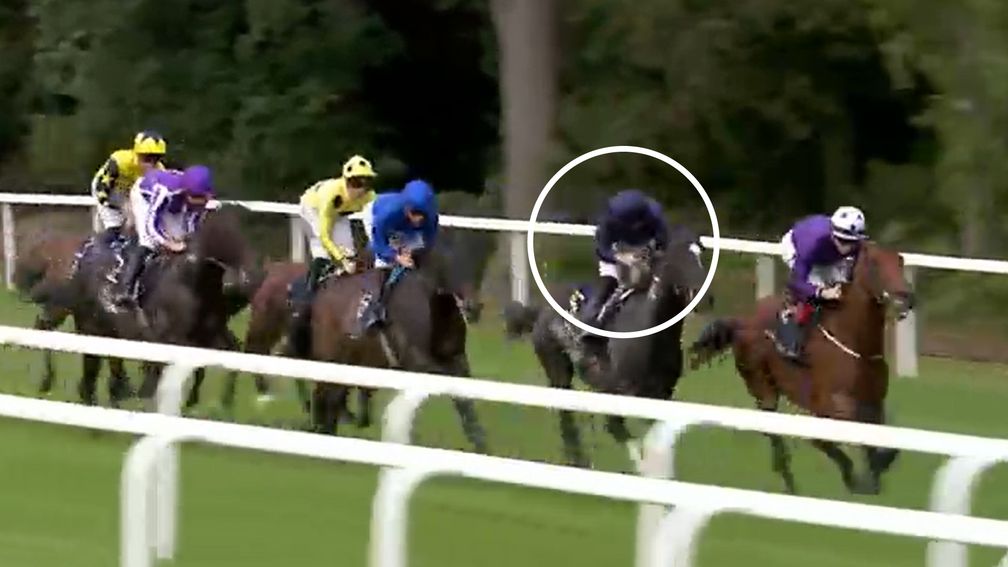
It was a rough race. Moore was suspended for three days for moving off the rail from his inside draw soon after the start, causing early interference to rivals, including Bow Echo. At the same time, stable companion Puerto Rico, who was acting as pacemaker for Gstaad, was rushed up by Soumillon to dispute a strong early gallop with outsider Power Blue. After just a furlong-and-a-half, Soumillon looked around (pictured above, dark jacket) to see where Gstaad (purple colours) was, seemingly confirming his intention to ensure the best possible conditions for his stablemate. This is not proof of ‘team tactics’ or deliberate instructions from trainer Aidan O’Brien, but it suggests the star Belgian rider was personally determined to ensure his mount would provide the best possible opportunity for Gstaad to have optimum conditions to attempt to defeat Bow Echo. It’s a very fine line.That impression was further reinforced when Soumillon again looked around at the three furlong marker to see where Moore was.
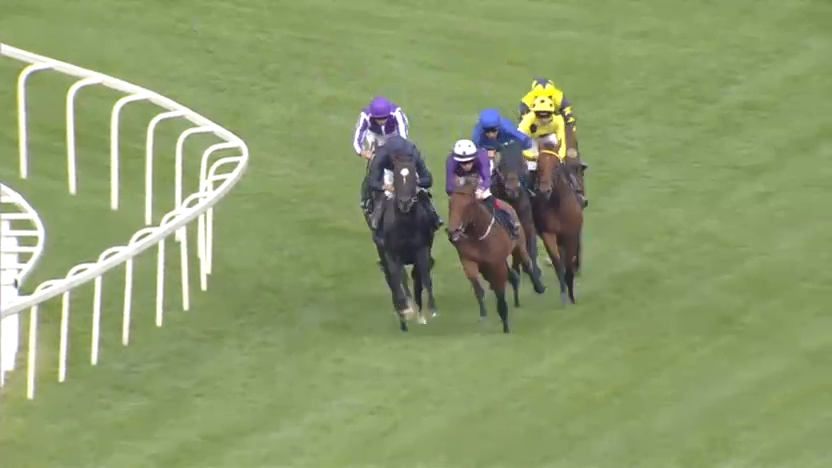
Soumillon, who had raced three horse-widths off the inside rail throughout the contest, left a big gap on his inner (almost certainly intended specifically for Gstaad) as they swung into the home straight (pictured below). At Thursday’s appeal he argued that this was because there had been a group of noisy schoolchildren standing at that point earlier in the day and he didn’t want their shouting to upset his mount, but this stretches credibility to the limit. Soumillon would clearly have seen that the children were not there as he galloped down to the start, and again were not there in the race itself. Remarkably, the appeals panel appears to have wholly or partially accepted this flimsy argument in mitigation, even though his riding well wide of the rail allowed Gstaad a clear run through, while Bow Echo had to come around the field from his wider race position.
Puerto Rico, a smart horse in his own right who won two Group 1’s last season, eventually faded fast and finished a well beaten last of six, Soumillon (pictured above) never at any point resorting to the whip. In British horse racing, every horse is expected to run to its individual merits and achieve the best possible position. Soumillon – who later at the meeting managed to get beaten on French star Goliath when losing his irons inside the final furlong as he came to challenge – was clearly asked to set a strong pace in the race that would most likely benefit his stable companion Gstaad. That isn’t to say it wouldn’t benefit others horses too, so trying to argue that Puerto Rico’s ride was designed specifically to aid one particular horse is futile, but there was something highly unsatisfactory with the star jockey’s ride and the raceday stewards quite rightly took a dim view of what they saw.
Quite how the disciplinary panel decided to reduce Soumillon’s ban is beyond me. His defence lawyer may have made a brilliant case and placed doubt in the collective minds of the panel, but all common sense and experience suggests this was a bad decision. It doesn’t do the reputation of our great sport any favours at all. Between them, Soumillon and Moore picked up a total eleven days bans – now reduced to a total of eight days – for their riding of the two O’Brien horses in this race. That surely speaks for itself as to what appeared to be happening, and what most of us – including the Royal Ascot stewards – saw with our own eyes.
The only real justice handed out in this sorry affair was that, in the end, Bow Echo managed to just win the race. Poetic justice, one might say.
Paul Alster has broadcast and reported on the British racing industry for four decades as a commentator, journalist, TV and radio presenter, betting correspondent, SP Returner, tipster and form analyst, among other things.